
News
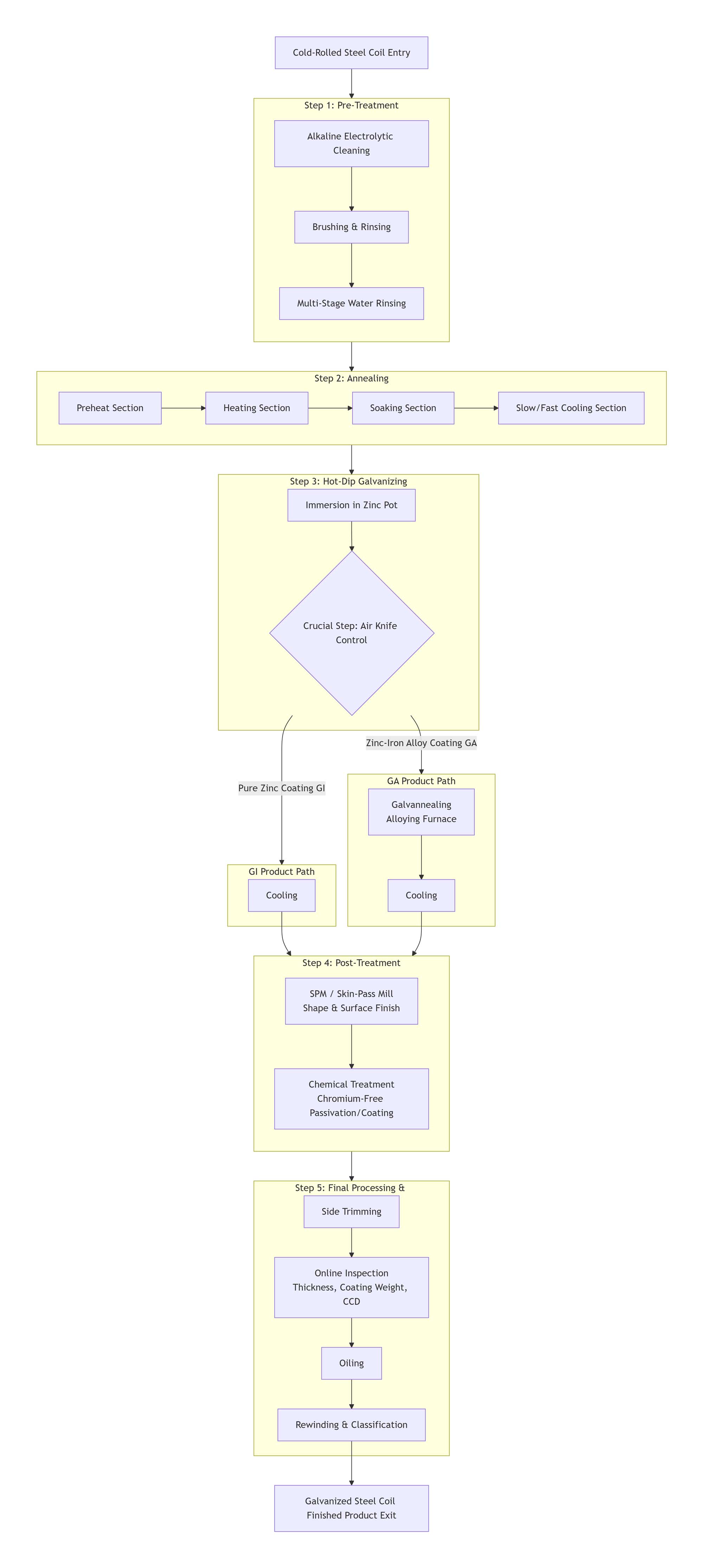
1. Pre-Treatment (Cleaning)
Objective: To thoroughly remove rolling oils, lubricants, iron dust, and other organic/inorganic contaminants from the surface of the cold-rolled steel sheet, providing a highly clean and active surface for subsequent processes.
Process Details:
Alkaline Electrolytic Cleaning: The steel strip acts as the cathode (or anode) in an alkaline solution (e.g., NaOH, Na₂CO₃, surfactants) with direct current applied. Electrolysis generates large amounts of gas (H₂ or O₂), which vigorously scrubs and strips away oil and dirt, while also saponifying and emulsifying grease. This method is far more efficient than simple soaking.
Multi-Stage Rinsing: After electrolytic cleaning, the strip passes through multiple stages of hot and cold water in a counter-current flow to remove residual alkali and impurities, ensuring a neutral surface.
Key Control Points: Solution concentration, temperature, current density, conductivity, strip tension.
2. Annealing
Objective: To eliminate work hardening from cold rolling via recrystallization in a reducing protective atmosphere, thereby restoring the sheet's ductility and toughness and obtaining a microstructure suitable for deep drawing (e.g., equiaxed ferrite grains).
Process Details:
Furnace Atmosphere: Typically a H₂-N₂ mixed gas (e.g., 75% N₂ + 25% H₂). Hydrogen acts as a strong reducing agent, capable of reducing any thin oxide film that may form on the steel surface, ensuring direct contact between pure iron and the molten zinc.
Annealing Curve: The strip is heated above the recrystallization temperature (typically 700-850°C), held for a specific time, and then precisely cooled to the pot entry temperature (approx. 460-480°C).
Key Control Points: Heating and cooling rates, soaking temperature and time, dew point control (< -40°C), hydrogen ratio.
3. Hot-Dip Galvanizing
Objective: To immerse the annealed steel strip into molten zinc to form a metallurgically bonded zinc coating.
Process Details:
Zinc Pot: A container holding molten zinc at about 460°C. It typically contains a small amount of aluminum (0.15-0.25% Al) to inhibit excessive growth of brittle Fe-Zn intermetallic compounds and improve coating adhesion.
Air Knives: Immediately after exiting the zinc pot, the strip passes through an air knife system consisting of a pair of slit nozzles. Jets of high-pressure air or nitrogen precisely scrape off excess zinc, controlling the final coating weight (typically 60-275 g/m² total for both sides).
Key Control Points: Zinc bath temperature and composition, sink roll depth and stability, air knife pressure/distance/angle, line speed.
4. Galvannealing (Alloying Treatment)
Objective: To convert the pure zinc coating into a zinc-iron alloy layer, producing galvannealed steel sheet.
Process Details:
The galvanized strip immediately enters an alloying furnace (often induction heated) and is briefly heated (10-30 seconds) at 500-560°C.
During this process, iron atoms diffuse from the substrate into the zinc layer, and zinc atoms diffuse into the iron, forming a dense alloy layer primarily consisting of the delta phase (FeZn₇). The surface appears matte grey without spangle.
Product Characteristics: The coating offers excellent paint adhesion, weldability, and corrosion resistance, but slightly lower formability compared to pure zinc coatings. This is an optional step for producing specific GA-grade products.
5. Skin Pass and Chemical Treatment
Objective: To improve the final product's surface quality and corrosion resistance.
Process Details:
Skin Pass/Temper Rolling: The sheet undergoes slight plastic deformation (approx. 0.5%-1.5% elongation) in a skin pass mill. This eliminates the yield point elongation to prevent Lüders bands during subsequent stamping, while also improving flatness and surface finish.
Chemical Treatment (Passivation):
Objective: To prevent the formation of "white rust" (basic zinc carbonate) during storage and transportation, and to provide short-term corrosion protection and enhanced paint adhesion.
Leading Technology: Chromium-free passivation. A very thin (tens to hundreds of nanometers) inorganic/organic composite film (containing Zr, Ti, Si oxides or organic compounds) is applied via roller coating or spraying.
Key Control Points: Skin pass elongation, passivation solution chemistry and pH, coating weight, drying temperature.
6. Inspection and Coiling
Objective: To ensure the final product meets customer specifications and to prepare it for shipment.
Process Details:
Online Inspection: 100% continuous monitoring using X-ray coating gauges, laser flatness scanners, and automated surface defect detection systems.
Finishing Operations: Side trimmers cut irregular edges; an oiling unit applies a thin protective oil film.
Final Inspection: Manual sampling at an inspection station to verify surface quality, dimensions, etc.
Coiling and Packaging: The strip is coiled by a tension reel, then strapped, covered with protective hoods, and labeled as required.
Key Control Points: Product identification, weight, appearance, packaging integrity.
RECENT NEWS
Online Message