
News
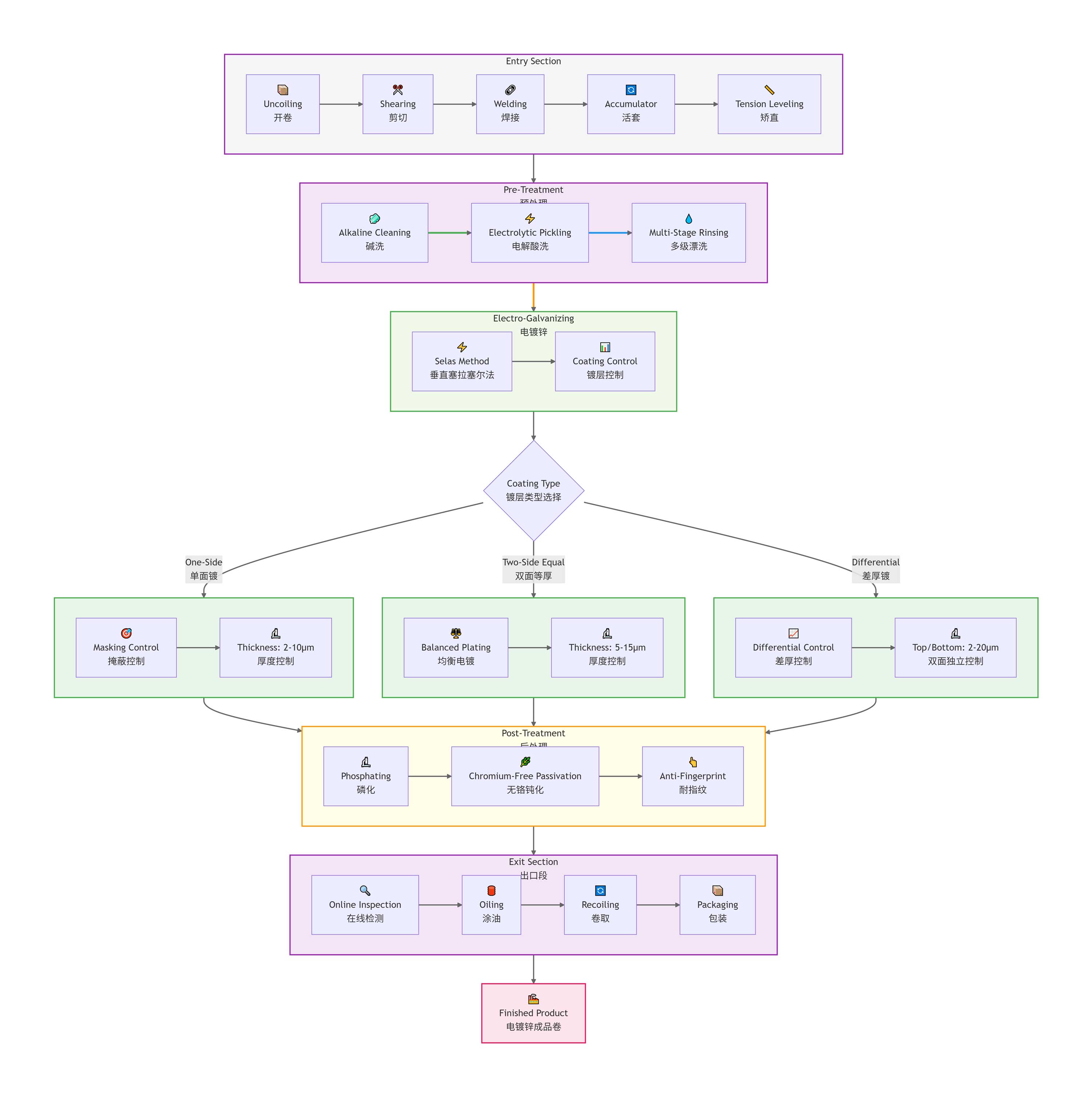
1. Entry Section
Equipment: Uncolier → Shear → Welder → Entry Accumulator → Tension Leveler.
Functions:
Uncoiling & Splicing: Uncoils cold-rolled steel coils (from Continuous Annealing Lines or recoiling lines) and joins the trailing end of one coil to the leading end of the next using a narrow overlap welder for continuous operation.
Accumulator Storage: The entry accumulator stores a sufficient length of strip, allowing the process section (cleaning, plating) to continue at high speed while the entry section stops for coil changeovers and welding.
Strip Preparation: The tension leveler removes coil set (crossbow) and edge wave, ensuring the strip enters subsequent precision processes flat, straight, and centered.
2. Pre-Treatment (Cleaning & Activation)
Objective: To obtain an absolutely clean, chemically activated metallic surface for optimal coating adhesion.
Typical Process Flow:
Alkaline Electro-Cleaning: The strip acts as the cathode in a hot alkaline solution. Electrical current causes gas evolution (H₂), which physically scrubs away rolling oils and greases, aided by saponification.
Electrolytic Picking: Electrolysis in a dilute sulfuric or hydrochloric acid bath effectively removes the thin oxide layer and iron fines.
Multi-Stage Rinsing: Deionized water is used for spray and immersion rinsing to completely remove residual acid/alkali electrolytes.
Critical Point: Even trace contaminants can lead to poor adhesion, blistering, or bare spots in the zinc coating.
3. Electro-Galvanizing Section (Core Process)
Principle: With electrical current applied, zinc ions at the strip surface (cathode) gain electrons and are reduced to metallic zinc, which deposits onto the steel.
Main Process Methods:
Selas Method (Vertical): The strip passes vertically through the plating cell, receiving current via conductor rolls. Precise anode placement and masking allow for one-side (OS), two-side equal (EQ), or differential (DF) coating. This offers high flexibility and is the mainstream technology for producing automotive differential coated sheets.
Horizontal Radiant Type: The strip passes horizontally with anodes above and below, enabling simultaneous two-side plating. This design is compact and efficient.
Process Control:
Plating Solution: Mainly acidic chloride or sulfate baths containing zinc ions, conducting salts, brighteners, and stabilizers.
Key Parameters: Current Density (determines plating rate), bath temperature, pH, zinc ion concentration.
Coating Weight Control: Achieved through closed-loop automatic control using Ampere-minute meters for precise charge calculation.
4. Post-Treatment (Coating Conversion & Protection)
Objective: To enhance the short-term corrosion resistance, paint adhesion, and special functional properties of the electro-galvanized sheet.
Main Processes:
Phosphating:
A microcrystalline phosphate conversion coating (e.g., zinc phosphate) is formed on the zinc surface via chemical or electrochemical reaction.
Functions: ① Provides short-term rust prevention. ② Serves as an excellent paint base, enhancing paint adhesion. ③ Reduces "white rust" formation during storage/transport.
Chromium-Free Passivation:
The modern, environmentally friendly standard. Uses solutions containing zirconium, titanium, silicon, etc., to form a dense oxide film.
Provides good, eco-friendly corrosion resistance.
Anti-Fingerprint (AFP) Treatment:
Applies a very thin organic or organic-inorganic hybrid coating.
Functions: ① Prevents fingerprint corrosion from sweat/oils. ② Improves corrosion resistance. ③ Provides some lubricity, enhancing formability in subsequent stamping.
5. Exit Section
Equipment: Exit Accumulator → Online Inspection System → Oiler → Tension Reel → Automatic Packaging Line.
Functions:
Accumulator & Inspection: The exit accumulator ensures continuous process section operation during exit operations. Equipped with X-ray Fluorescence (XRF) coating gauges and surface inspection cameras for 100% online quality monitoring.
Finishing & Recoiling: An oiler applies a micro-thin layer of protective oil. The tension reel winds the strip under constant tension to form the finished coil.
Packaging: The automatic packaging line performs strapping, edge protection application, and wrapping with anti-rust paper/film to shield the product from damage and corrosion during handling and storage.
RECENT NEWS
Online Message