
News
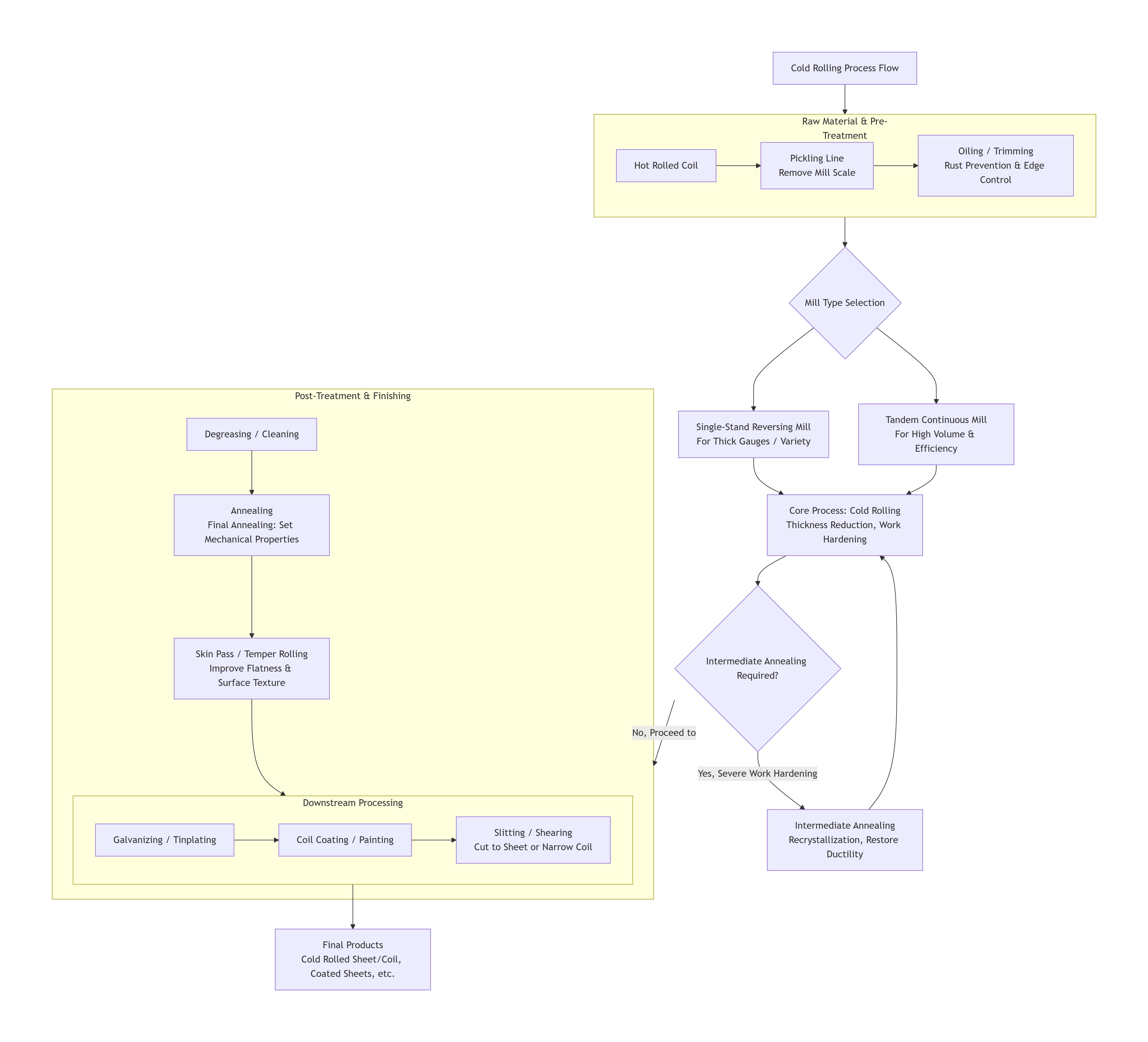
Step 1: Material Preparation — Pickling
Purpose: To remove the iron oxide scale from the hot-rolled coil surface, providing a clean, smooth substrate for cold rolling.
Process: Typically Hydrochloric Acid Pickling. The hot-rolled coil is uncoiled in a continuous pickling line, passes through acid tanks where the scale is chemically dissolved, followed by rinsing and drying.
Output: Hot Rolled Pickled (HRP) Coil, the direct feedstock for cold rolling.
Step 2: Core Process — Cold Rolling
Purpose: To significantly reduce the thickness of the pickled coil and improve flatness.
Equipment: Main types include:
Single-Stand Reversing Mill: Suitable for multi-variety, small-batch production. The strip is rolled back and forth for multiple passes on the same stand.
Continuous Tandem Mill (e.g., 5-stand): For high-volume production. The strip passes continuously through 3-6 stands in series, reaching the target thickness in one pass at very high speeds (up to 2000 m/min).
Process Characteristics:
Requires enormous rolling force, powerful mills, and motors.
Uses rolling oil for lubrication and cooling.
Causes significant work hardening. The rolled material is called Full-Hard Coil, which is high in strength but low in ductility, unsuitable for deep drawing without further treatment.
Step 3: Heat Treatment — Annealing
Purpose: To eliminate work hardening from cold rolling, restore ductility and toughness, and achieve the desired microstructure (e.g., recrystallized grains).
Main Annealing Types:
Batch (Bell/Hood) Annealing: Coils are stacked, sealed under inner and outer covers with a protective atmosphere (e.g., H₂+N₂), and subjected to long heating, soaking, and cooling cycles (tens of hours). Suitable for medium/heavy gauges and large batches.
Continuous Annealing: The strip passes continuously through a long furnace with heating, soaking, slow cooling, and rapid cooling sections. The entire process takes only minutes. It offers high efficiency, uniform properties, and better surface quality, and is the mainstream technology in modern lines. Output is Annealed Coil.
Step 4: Finishing & Post-Treatment
This is the critical step that imparts final properties and form to the cold-rolled product, with highly flexible process combinations.
Skin Pass / Temper Rolling:
The annealed strip undergoes a very light reduction (0.3% to 3%) in a low-force mill (skin pass mill).
Functions: Eliminates the yield point elongation to prevent Lüders bands during stamping; improves flatness and surface finish; imparts desired mechanical properties (e.g., a specific hardness).
Surface Treatment (Selected based on end-use):
Galvanizing: Continuously coats the strip with a zinc layer to produce Galvanized Steel for corrosion resistance (e.g., automotive, appliances, construction).
Hot-Dip Galvanizing: Immersion in molten zinc.
Electro-Galvanizing: Electrolytic deposition for more uniform, precisely controlled coating.
Tinplating: Produces Tinplate for food and beverage cans.
Coil Coating / Painting: Applies organic paint or film on galvanized or other substrates to produce Pre-Painted/Color Coated Coils for building roofs and walls.
Electrical Steel Treatment: Applies insulating coatings to silicon steel coils for motor and transformer cores.
Finishing Operations:
Slitting: Cutting the wide coil into multiple narrow strip coils.
Cut-to-Length/Shearing: Uncoiling, leveling, and shearing the coil into discrete sheets/plates.
Rewinding/Re-coiling: For inspection and repackaging.
Inspection & Packaging:
Rigorous testing for dimensions, surface quality, mechanical properties, and coating performance.
Sophisticated packaging for rust prevention and scratch protection before dispatch.
RECENT NEWS
Online Message