
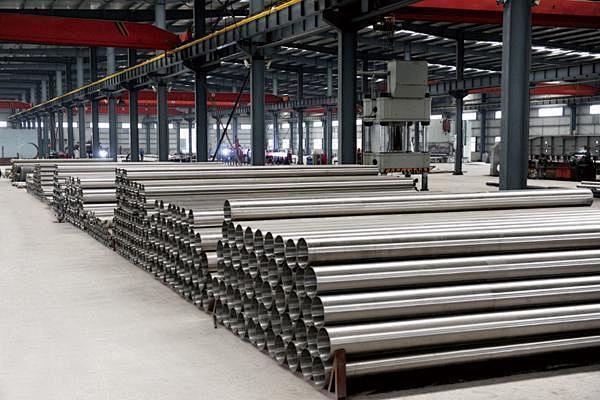
I. Core Principle & Fundamental Difference
Seamless Steel Pipe: Manufactured by piercing a solid billet and then hot-rolling/extruding. It has no longitudinal weld seam.
Welded Steel Pipe: Formed by rolling steel plate or coil into a cylindrical shape and then welding the seam. It contains a longitudinal or spiral weld seam.
II. Five Practical Identification Methods (From Easiest to Most Advanced)
1. Visual & Tactile Inspection (Most Direct)
Look for the Weld Seam:
Welded Pipe: Closely inspect the inner and outer surfaces. You will typically find a continuous straight or spiral line (the weld seam trace). The inner and outer weld beads may not align perfectly. Running a finger along it may reveal a slight ridge or depression.
Seamless Pipe: Surfaces are smooth with no continuous longitudinal weld seam. There may be spiral rolling marks, but these are uniform and continuous, lacking welding-specific features like undercut or bead reinforcement.
Observe the Pipe End:
Look at the cross-section. Welded pipes may have slightly greater wall thickness tolerance, and a slight internal bead or burr may sometimes be visible at the weld line inside.
2. Inference from Process Characteristics
Dimensions & Wall Thickness:
Large Diameter / Thin Wall: Mostly welded pipe (seamless piercing technology has limitations for very large diameters or extremely thin walls).
Small Diameter / Thick Wall: Commonly seamless pipe.
Pipe Markings / Stenciling:
Check product labels or stenciled codes. Standard designations often differ:
Seamless Pipe: GB/T 8163 (for fluid conveyance), GB/T 6479 (for high-pressure fertilizer equipment), API 5L (line pipe, specifying Seamless).
Welded Pipe: GB/T 3091 (for low-pressure fluid), GB/T 9711 (for oil & gas transmission, specifying Welded), SY/T 5037 (spiral welded pipe).
Material Grade Hints: Grades like 20#, 45# steel are common for seamless; Q235, Q345 are common for welded pipes.
3. Non-Destructive Testing Methods (Professional & Accurate)
Ultrasonic Testing (UT): Detects internal discontinuities. The weld zone in a welded pipe is a key inspection area, producing a distinct signal signature different from the base metal.
Eddy Current Testing (ECT): Sensitive to surface/near-surface flaws. Can clearly identify differences in electromagnetic properties between the weld, heat-affected zone (HAZ), and base metal.
Radiographic Testing (RT) / Industrial TV: Provides a direct image of the weld seam, considered the "gold standard" for confirming welded construction.
4. Destructive Testing (Definitive Confirmation)
Metallographic Examination: Examine a cross-sectional sample under a microscope. A welded pipe will show distinct microstructural differences between the weld metal, heat-affected zone (HAZ), and base metal. A seamless pipe shows a uniform structure throughout.
5. Deduction from Application Context
High-Pressure, High-Temperature, Critical Load-Bearing Structures (e.g., boiler tubes, hydraulic cylinder barrels, aircraft landing gear): Almost exclusively use seamless steel pipe.
Low-Pressure Fluid Conveyance, Structural Support, Guardrails, Scaffolding: Mostly use welded steel pipe (cost-effective).
Long-Distance Oil & Gas Pipelines: Main large-diameter trunk lines often use High-Frequency Welded (HFW) or Spiral Submerged Arc Welded (SSAW) pipe; branch lines or high-pressure sections may use seamless pipe.
III. Key Points for Identifying Different Types of Welded Pipes
Longitudinal Welded Pipe: The weld seam is a straight line. High-Frequency Welded (HFW) pipe seams can be very fine and require close inspection.
Spiral Welded Pipe: The weld seam forms a clear spiral/helical line, making it easy to identify.
Submerged Arc Welded (SAW) Pipe: The weld bead is wider and has noticeable reinforcement (crown).
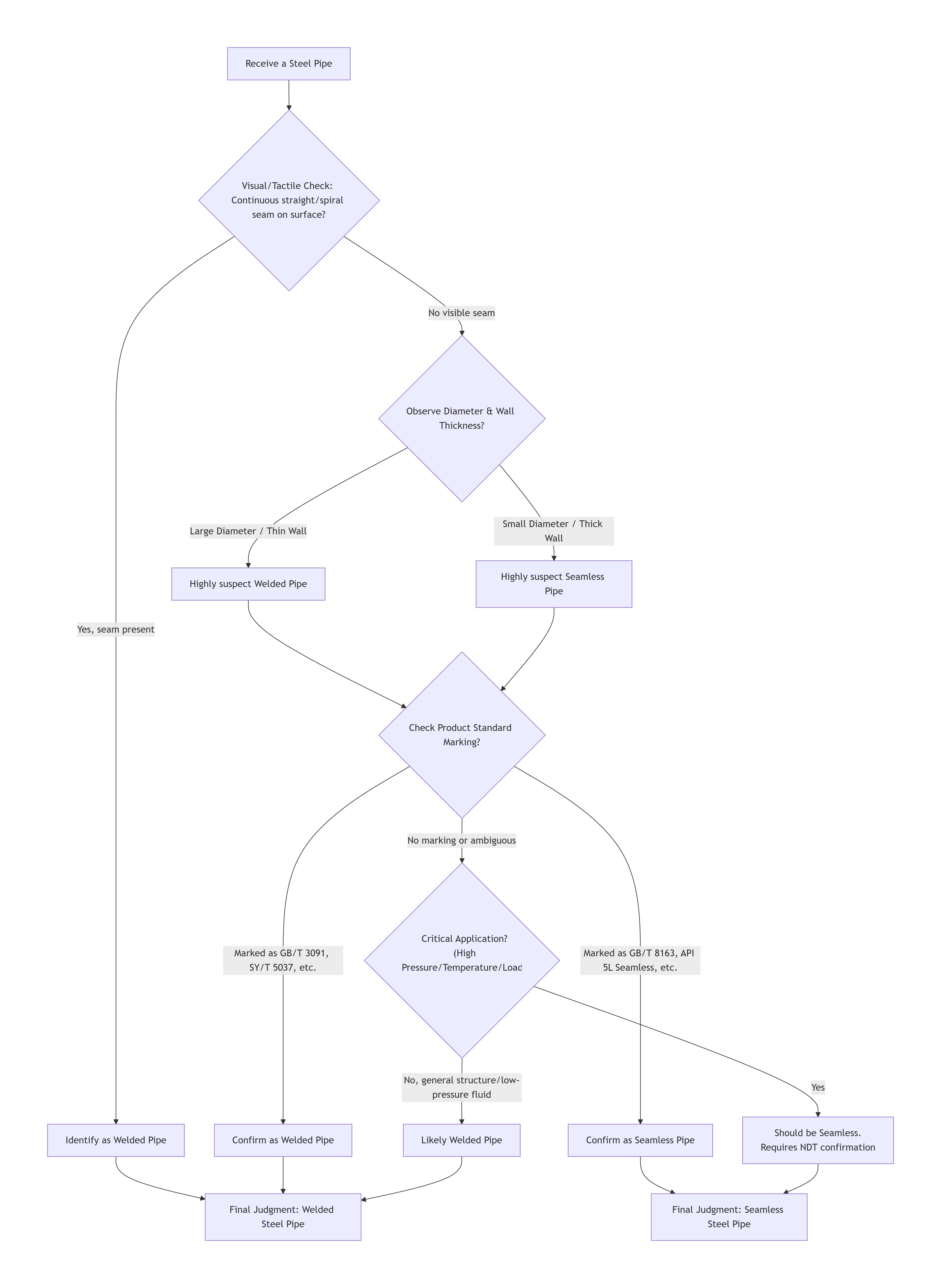
IV. Quick Decision Flowchart
V. Important Reminders
Seamlessized Welded Pipe: Some welded pipes undergo hot expansion or cold drawing, and the weld seam is ground flush, making them appear seamless. In such cases, Ultrasonic or Eddy Current Testing is essential to detect the hidden weld seam.
Do not rely solely on "feel" or "experience" for final judgment on pipes for critical applications. Combining standard markings with NDT is the most reliable approach.
The purchase contract must explicitly specify "Seamless" or "Welded" and cite the product standard. This is the most fundamental safeguard.
Summary: The most practical on-site method is the "Three-Step Check": 1) Look (for the seam), 2) Feel (for ridges), 3) Check (the standard code). For critical applications or difficult-to-identify pipes, professional judgment via Ultrasonic Testing is mandatory.
RECENT NEWS
Online Message